Neighborhoods in Change
Neighborhoods in Change was a joint initiative of Shahaf Foundation, the Neighborhood Rehabilitation Division at the Ministry of Construction and Housing, the Young Adults Authority at the Ministry for Social Equality, the National Insurance Institute’s Fund for Special Projects, and local authorities.
The pilot began in January 2020 and operates in four neighborhoods across Israel: Hadar in Haifa, Sharet in Lod, Kiryat Yovel in Jerusalem, and Mitzpe Ramon.
The initiative aimed to improve quality of life for all population groups in each neighborhood through a systemic, holistic approach, with particular emphasis on populations at risk.
Change in each neighborhood was driven by coordinated action: a meaningful, long-term partnership with local authority representatives to advance the neighborhood; an engaged civil society led by mission-driven communities and young activists; and a cross-sector partnership investing in the neighborhood.
The initiative worked to strengthen each neighborhood and make it attractive to young adults, young families, and all residents by implementing a multi-year strategy for systemic, fundamental, long-term change. The process focuses on social and community action in education, culture, community life, welfare, and personal safety, engaging the neighborhood’s diverse populations, including older adults and young people at risk, with mission-driven communities taking the lead.

Key Achievements:
-
Approximately NIS 5.5 million in additional investment in the neighborhoods
-
725 neighborhood activists — a 400% increase in the number of activists
-
40 community projects involving more than 8,000 residents
-
Four new communities established — 100 young adults chose to stay in or move to the neighborhoods
-
Four neighborhood networks established
-
Support for approximately 12,000 neighborhood residents during the COVID-19 pandemic
-
Assistance for 730 older adults in accessing their rights and benefits
To view the full initiative model, click here.
“What is happening in Hadar is urban renewal centered on people and community. Hundreds of young adults, driven by purpose and ideals, were captivated by the neighborhood’s charm and diverse population. They found meaning in taking action for their immediate neighbors and for the neighborhood as a whole, alongside local activists, parents, and older adults from different backgrounds, ethnicities, and nationalities. They live together in a multicultural, diverse neighborhood and see that diversity as an asset: an opportunity to create a society that places people and human relationships at its heart. Those who chose to move to Hadar feel enriched every day. Nothing can replace the personal connections formed here or the sense of purpose you can create for yourself, your family, and those around you.”
Keren Segi, Hadar Neighborhood Coordinator, Haifa
Pilot Neighborhoods
Mission-driven communities as a catalyst for community renewal in four neighborhoods in Israel’s geographic and social periphery
Sharet Neighborhood, Lod
Sharet is located in Lod’s older southern district and is home to approximately 5,000 people. In recent years, the neighborhood has seen two parallel trends: an aging long-established population and a growing number of younger residents moving into the area. A large proportion of Sharet’s residents are members of the Ethiopian community and immigrants from the former Soviet Union.
Key Activities:
-
Neighborhood celebrations — Resident-led events around Jewish and Israeli holidays and other themes, strengthening the local community.
-
Establishing a family center — Family Time: connecting families and supporting young parents.
-
A club for new mothers — Support and connections for mothers in the neighborhood following childbirth.
-
Establishing a new community of local residents — A community of local families sharing a community-oriented way of life and organizing activities for all neighborhood residents.
-
Leisure activities for children and young people — Including Family Thursdays, pajama parties in residential buildings, and more.

Hadar Neighborhood, Haifa
Founded in 1922, Hadar is one of Haifa’s most historically significant neighborhoods. As conditions deteriorated over the years, the municipality decided in the early 2000s to advance neighborhood renewal. Today, Hadar is home to approximately 40,000 residents and is known for its remarkable social diversity. Jews and Arabs; secular, religious, and ultra-Orthodox residents; long-established residents and immigrants live together in a relatively dense area. Its distinctive character creates opportunities for meaningful encounters, vibrant social activity, and community life with an entrepreneurial spirit. Hadar faces numerous challenges in education, welfare, housing, and personal safety, while seeking to preserve its residents’ unique and diverse character.
Key Activities:
-
The social network — A network of activists working with the municipal welfare department to meet the needs of different population groups in the neighborhood, supporting the comprehensive civil assistance system developed locally.
-
Older adults — Assistance in accessing rights and benefits, documenting life stories, reducing loneliness, and more; cultural activities for older adults; and a neighborhood group of older community activists.
-
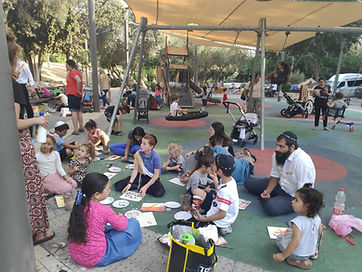
Community parks — A rich and varied program that makes neighborhood public parks meaningful community hubs and improves personal and public safety through better services and infrastructure, community activities, a mobile café, sports, and culture.
-
Families and early childhood — Building a neighborhood community of families that provides a welcoming home for young families, develops parent leadership, and strengthens support in this area.
-
Strengthening neighborhood communities — Consolidating, supporting, and strengthening the mission-driven communities of young adults who live and work in the neighborhood.

Mitzpe-Ramon
Mitzpe Ramon is home to approximately 5,700 residents, including 2,300 young adults. It is one of Israel’s youngest towns, with 40% of residents under the age of 40. The town’s development and distinctive characteristics have made it a draw in recent years for young adults, domestic and international visitors, artists, and others. Its diverse population comprises several communities with different cultural characteristics.
Key Activities:
-
Local Family — A program in which long-established families welcome new families, promoting a sense of belonging and local pride.
-
The Tseela community in Mitzpe Ramon’s older neighborhoods — Strengthening the community fabric and developing local leadership, establishing building committees, and launching initiatives to improve quality of life in the town.
-
Establishing an educators’ community — Community and social support for local teachers, offering a space for personal growth and a shared language across different educational streams.
-
Advancing social mobility — A joint initiative with the Rashi Foundation to reduce inequalities and improve social mobility for Mitzpe Ramon’s residents.

Kiryat-Yovel Neighborhood, Jerusalem
Kiryat Yovel, in western Jerusalem, is home to approximately 20,000 residents from diverse backgrounds and ways of life, making it a microcosm of Israeli society. It is home to many communities, both younger and older, that work with the local authority to improve neighborhood quality of life, develop community responses in various fields, and build connections among people. The neighborhood is rich in local strengths and activists who advance the community and its residents, creating a better everyday reality through care, shared responsibility, and action for the common good.
Key Activities:
-
A creators’ group — Local creators and artists meeting to develop original work and community activities.
-
The HaYovel network — A neighborhood network that encourages volunteering, activism, varied opportunities to meet, and mutual community support in responding to local needs.
-
A welcoming program — Helping new residents settle into the neighborhood and become part of its existing community fabric.
-
The “Neighborhood for All” project — Developing neighborhood leadership that represents its diverse populations — secular, religious, and ultra-Orthodox — through action for the common good and conflict resolution.
-
Shared courtyards — Strengthening communality and shared life in neighborhood residential buildings to improve quality of life.
-
Neighborhood for All — A model for a mixed neighborhood that connects secular, religious, and ultra-Orthodox residents, transforming a neighborhood marked by conflict into one where diversity is an asset.